

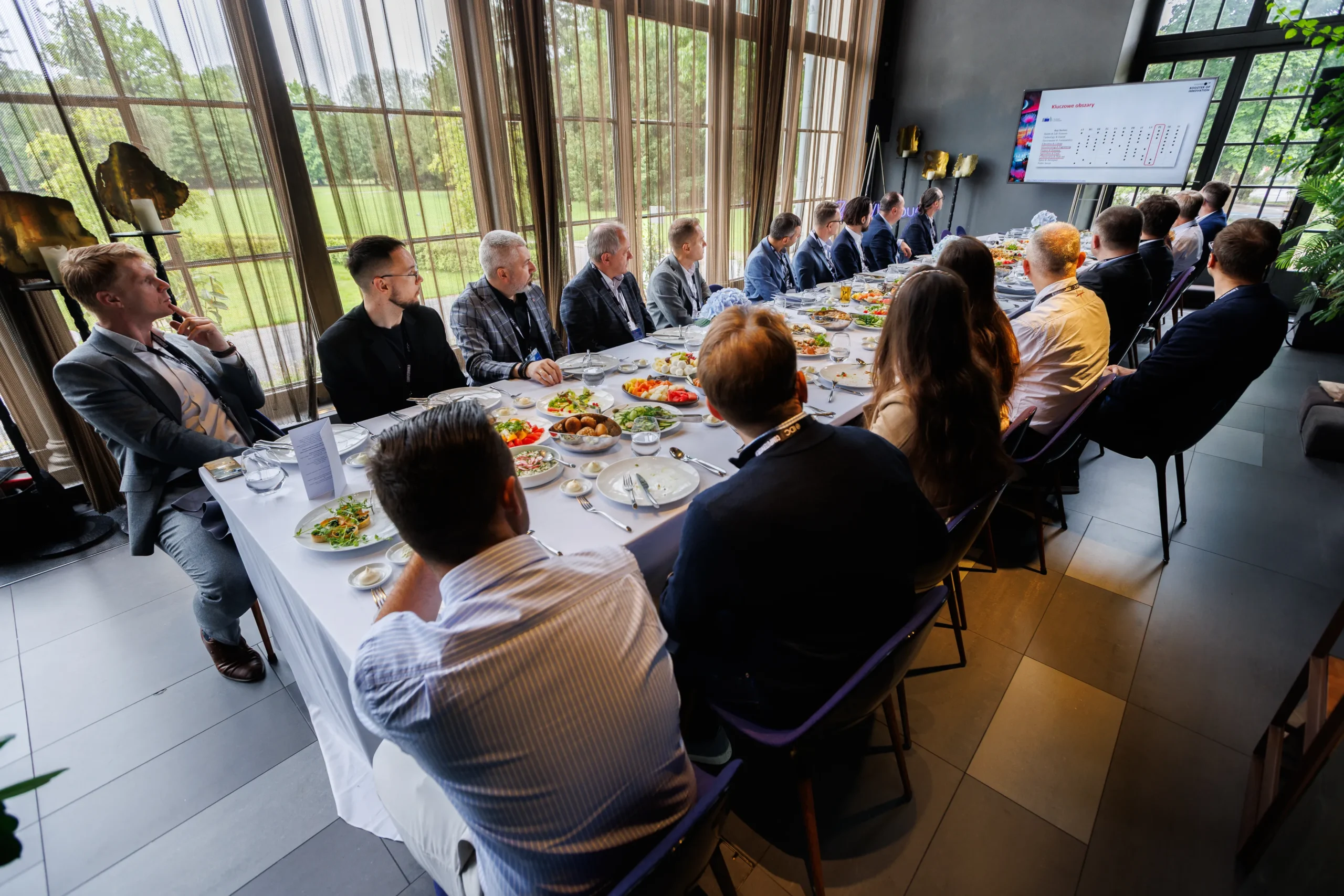
A presentation at an OVHcloud business breakfast brought home the critical juncture Europe now faces. In the global tech race—especially in Cloud, AI and digital sovereignty—the Old Continent must make strategic, large-scale choices that will define its standing for decades. Passive observation is no longer an option. Europe’s future is crystallising between two competing visions: a “United AI Planet” versus the risk of “Fragmentation and a technology arms race.” In this context, Poland—still wrestling with an innovation gap—has a pivotal role to play.
Off the Blocks: Why Europe must accelerate
Macro analysis leaves little room for illusion. In the world economy, the US accounts for 26% of global GDP, while the EU and China each hold ~17% (current prices, 2023). The key takeaway is that no single European country can compete globally on its own. Our strength is the unity of 27.
Europe’s critical challenge is the productivity gap versus the US. While labour contribution explains –28% of the GDP per capita gap, –72% is down to productivity contribution. We don’t necessarily work less—we’re less effective.
The AI Continent Action Plan (European Commission Communication, 9 April 2025) is a strategic response designed to close that gap. Its InvestAI initiative targets €200 billion for large-scale infrastructure to enable open, collaborative development of the most advanced AI models—positioning Europe as the AI Continent.

Five pillars of Europe’s technological independence
The Commission’s plan is systemic, not one-dimensional. It stands on five interlocking pillars that must progress in parallel if Europe is to become a true AI Continent:
- Computing Infrastructure: Investment in AI Gigafactories and AI Factories (e.g., Poland’s PIAST AIF) to secure compute capacity for training advanced models.
- Data: The fuel without which AI innovation remains theory.
- Skills: Investment in human capital and future-ready competencies.
- Development & Adoption: Deploying AI across priority sectors—from Health to Cybersecurity & dual-use.
- Regulatory Simplification: A predictable legal environment that enables scale.
For Poland, priority beneficiaries include Health & Life Sciences, Environment & Sustainability, Education & Culture, the Public Sector, and Space & Aerospace—underlining the strategic nature of Poland’s place in Europe’s AI puzzle.
Three strategic lessons for Polish Boards
Poland currently sits at the back of the innovation pack: 40th in the Global Innovation Index 2024 and 23rd in the European Innovation Scoreboard 2024. More worrying, AI uptake among firms with 10+ employees has slid to 30th in Europe, at 5.9% in 2024 (vs 3.7% in 2023 and 29th place). This is our most pressing race against time.
Lesson #1 — Change the speed of AI deployment: from linear to exponential
We must abandon linear thinking about AI implementation. Pace is a precondition of success. Insight from GenAI in financial services is telling:
- In Poland, 87% of surveyed firms see revenue growth as the primary benefit of GenAI.
- Across Europe, it’s 79%; globally, 78%.
- Only 13% of Polish firms prioritise cost reduction (vs 21% in Europe; 22% globally).
This lens is right. AI is a foundation for new business models, not merely a process-optimisation tool. AI is not an IT issue—it is the No.1 strategic agenda for Leaders.
Lesson #2 — The Two-Speed (and Three-Track) Technology Investment Strategy
We cannot wait for fully European, end-to-end solutions. Boards must diversify tech bets via a Two-Speed Strategy:
- Track A: European Technologies (y%) — build resilience and technological sovereignty and ensure regulatory alignment. Actively back initiatives like PIAST AIF.
- Track B: Competitiveness Technologies (x%) — adopt best-in-class global solutions now (often US-origin) to win market share and drive revenue growth.
- Track C: Proprietary AI / Tech (z%) — invest in a unique competitive advantage built on your own data and capabilities. Poland’s BLIK is a standout precedent.
Lesson #3 — Why back Polish and European innovation?
Supporting European solutions isn’t patriotism—it’s strategy. The US innovation engine is scaled on four pillars that Europe and Poland must emulate:
- Defence & Public Procurement — create a large, guaranteed anchor market for innovative tech. Poland’s EU Council Presidency in 2025 puts Security & Defence (including tech) centre stage.
- Science (+Business) — turn research into commercial products.
- Finance — access to risk capital at speed.
- Single Internal Market — build unified, mass markets for innovation (cf. BLIK, reaching 1.5bn+ transactions in seven years).

Collaborate, collaborate, collaborate.
Europe’s AI future depends on our capacity to cooperate, move fast, and play as one team. We must support Europe’s march to technological independence while investing in Polish talent to create globally competitive home-grown solutions.
AI Continent is a credible plan—but its success hinges on Leaders who translate strategic vision into operational actioninside their organisations.
Is your AI strategy ready for exponential speed?
We turn chaos into clarity and design strategies that create genuine competitive advantage.
Download our latest framework, “AI Strategy Blueprint for the C-Suite,” and book a free 15-minute strategic consultation to define your organisation’s Three AI Investment Tracks. Don’t wait for AI to become compulsory—make it your edge.






0 Comments