

In the business world, we often kid ourselves that crises are anomalies — brief interruptions to “normality”, after which everything returns to the old tracks. Yet an analysis of the latest Russian strategic documents, along with the Valdai Club report titled “Dr Chaos, or How to Stop Worrying and Learn to Love Disorder”, suggests something quite different.
For leaders and strategic visionaries, the takeaway is brutal, but valuable: chaos isn’t an obstacle to executing strategy. It has to become its foundation.
Farewell to the Illusion of Recovery
A core claim of this new theory is that “the old world order cannot be rebuilt.” Any attempt to return to what was is doomed from the outset.
In business terms, waiting for supply chains to stabilise or for financial-market predictability to return is simply wasting time. The strategic direction is not to fix the old model, but to build on the rubble.
“A Variable Environment”: A New Definition of Agility
Russian analysts describe today’s world as a “variable environment”. In such conditions, traditional, rigid long-term planning becomes close to useless.
- Strategy.
Instead of building 3–5-year roadmaps, organisations need to shift to a model of “creative actions” taken in response to ongoing shocks.
- Advantage.
As the report’s authors note, “those who respond faster and more appropriately can benefit from shocks.”
- Our use case.
For a global fintech, we designed an AI strategy focused on detailed goals for year one. Later years are set as broad directions. What counts is strong initial prep and ongoing environmental scanning, as future scenarios are unpredictable. Today, constant strategic vigilance matters.
The Concept of the “Company-Civilisation”
One of the article’s most interesting ideas is the “state-civilisation” — a unique construct that doesn’t have to fit any external standards (neither Western nor Eastern) and is anchored in its own identity.
For companies, brands, and corporations, this is a powerful prompt to build radical authenticity. In global disorder, winners are organisations that:
- are self-sufficient in critical areas (technology, talent);
- don’t copy competitors; instead, create their own “value ecosystem.”
The “company-civilisation” concept is especially relevant in the era of mass AI adoption: build your own unique arsenal and, more importantly, anticipate the next moves.
Strategic Nihilism vs Partnerships
Chaos theory assumes that old rules and institutions (such as the UN or the IMF) have entered a systemic crisis and are being used instrumentally by stronger players.
In business, we see an erosion of trust in global standards and platforms (for example, Big Tech and growing dependency). Leaders should therefore:
- Reassess alliances.
In an age of chaos, partnerships become transactional. You need to be very cautious about entering any partnerships, prioritising flexibility over multi-year, rigid contracts.
- Rely on your own strength.
The key resource becomes your own “arsenal” – in business: data, IP, and the ability to recalibrate processes at speed.
Business Scenarios for 2026–2030
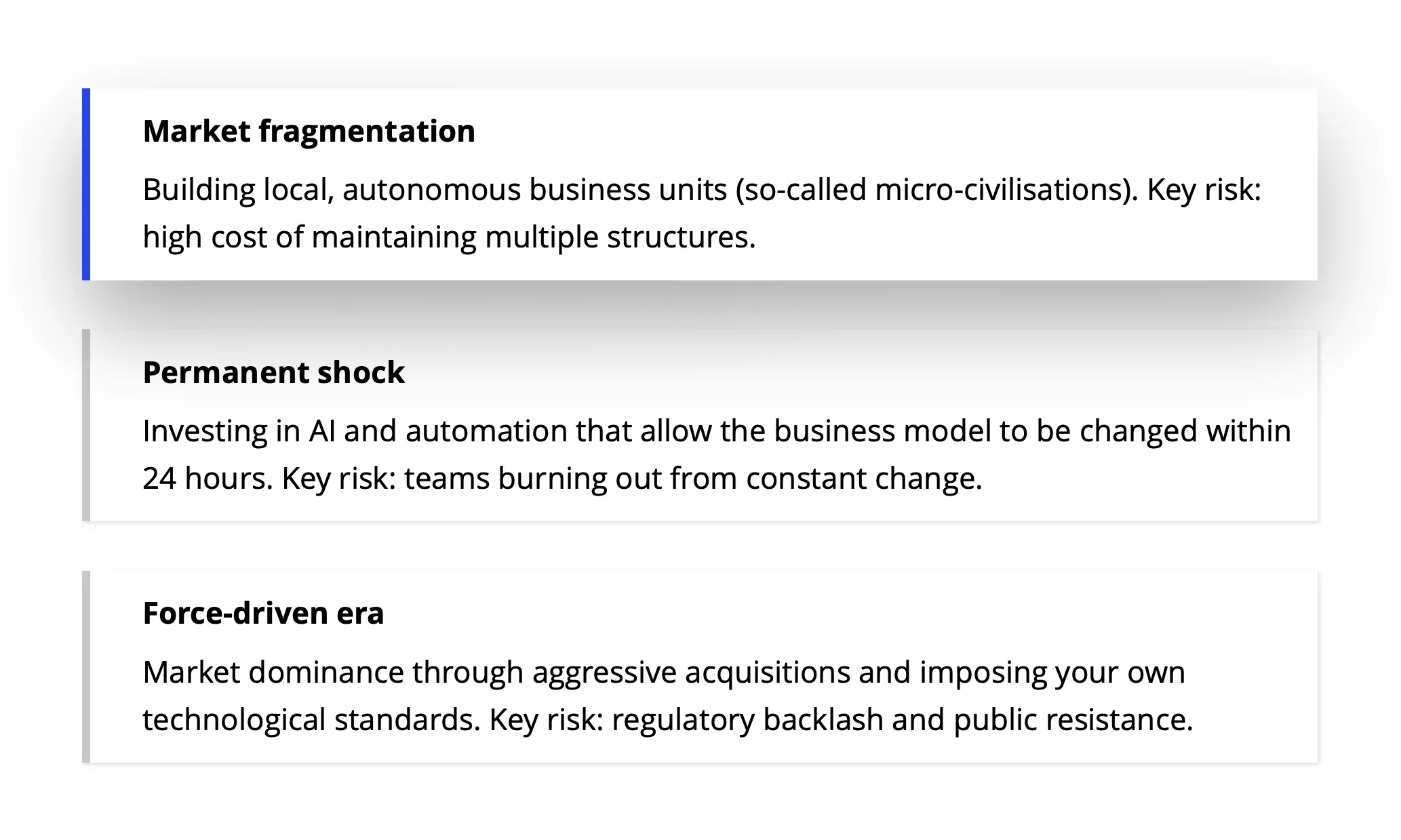
Can You “Learn to Love Disorder”?
Marcin Łuniewski’s article “The Kremlin Has Learned to Love Disorder”, published in Plus Minus, reminds us that chaos is the perfect environment for those who aren’t afraid to throw the textbooks out of the window. Although the Russian theory is largely a political instrument, its foundation the idea that a world governed by power and unpredictability requires a new form of strategic intelligence is universal.
Strategy in 2026 is not only about AI – it’s about innovating how your organisation manages uncertainty.
“Nothing relieves us of the duty to prepare for everything that may come.”
The author of this quote is… Putin. Sometimes it’s worth looking East as well to spot new vectors of geopolitical change. Our companies operate within these constellations, so it would be naïve not to notice the tremors signalling the collapse of the old world order.
Want to Prepare Your Organisation for Unpredictable Times?
If you’re wondering how to get your organisation ready for a new era of unpredictability, book a meeting and learn about our workshop, Business in an Age of Chaos. Instead of fear, we guide leaders through different chaos scenarios – building readiness to act and helping teams make peace with the new era.


0 Comments