

Artificial Intelligence (AI) is a term that excites, inspires, and sometimes… misleads. Many stories have grown around AI—classic myths that have little to do with the truth but have deeply embedded themselves in our collective thinking. Do you know how AI works, what it can do, and where its limitations lie? Get ready to challenge some common beliefs and discover the real face of your digital partner as we dive into the facts about generative AI.
AI has become integral to our everyday reality in today’s fast-paced, tech-driven world. We’re increasingly looking into how AI can be used in our work, education, and personal lives. But as its presence grows, so does the number of misunderstandings and false claims, which distort our view of AI. It’s time to set the record straight.
This article summarises the insights I shared during the first session of the “AI Your Way” webinar series dedicated to “Your Career Transformation with AI”. During the event, I cleared up many doubts and showed how generative AI works—and how to collaborate effectively. Enjoy the read and uncover what lies behind the scenes of artificial intelligence, especially if you’re interested in beginner-friendly AI or looking for practical AI insights.
The Most Common AI Myths – Time to Bust Them!
AI rapidly enters our professional and personal lives, promising revolutions in many areas and reshaping our future. But as generative AI gains popularity, it’s also surrounded by myths and misleading beliefs. Wondering what’s true and what’s not? Let’s take a realistic look at AI and separate fact from fiction.
Myth #1: You need to master prompting to use AI effectively
It’s widely believed that to use AI tools like ChatGPT, Gemini, or Copilot effectively, one must master the art of prompting. Many people feel the need to study prompt engineering, but what matters more is understanding how AI works and how to use it efficiently.
Good prompting skills are only part of the story. While crafting clear prompts helps, it’s not the most essential skill. To fully use generative AI, learning about meta-prompting is far more helpful—where you ask AI to generate the best prompt for the task. This approach leads to more accurate and creative results. You don’t need to know how to create good prompts—AI can do that for you! This marks a significant shift in learning new technologies: meta-prompting replaces long hours of studying through courses, books, or postgraduate programmes.
Knowing how to build good prompts is useful, but investing in studies or courses focused only on prompt engineering may no longer be wise.
If you’d like to start quickly, download our free ebook, “ABC of Prompting,” which outlines 10 practical steps for working with AI. For those ready to go deeper, check out our hands-on online course, “AI Chats: A Quick Course.” Both resources are ideal for beginners looking for an AI explanation.
Myth #2: AI can do all the work for us
Many people, influenced by science fiction, believe that AI can handle any task independently—from the simplest to the most complex. There’s a belief that once you give an instruction, AI will take care of everything and deliver perfect results. Some even describe it as AI magic.
Working with AI is more like solving a puzzle than waving a magic wand. It involves multiple steps, iterations, and ongoing interaction between humans and AI. The process includes idea creation, interactions with the AI chat, reviewing results, reflection, and using several generative AI tools (like ChatGPT, Gemini, Microsoft Copilot, NotebookLM, Gamma App), organising tasks in a sequence, and finally, evaluating the outcome.
Rather than seeing AI as something that works for us, we should treat it as a powerful tool that requires our engagement and cooperation to unlock its full potential.
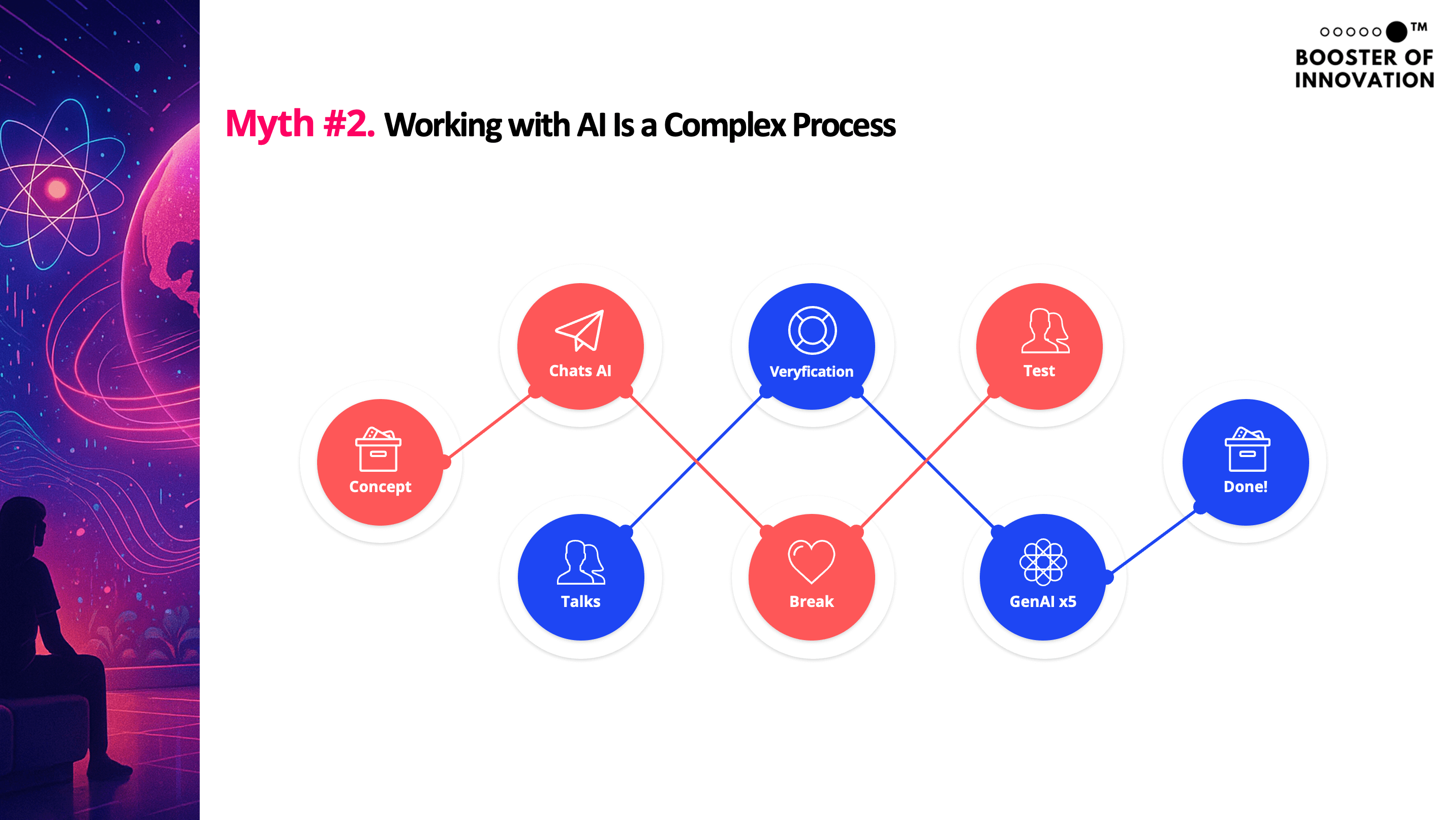
It’s also helpful to use follow-up prompting to refine results, ask AI to redo a task, or request alternative outputs (and be specific about what you need). If you’re looking for beginner-friendly Polish-language AI resources, the ebook or course “AI Chats: A Quick Course” will give you a hands-on start and help you truly understand how generative AI works.
Myth #3: Generative AI is easy to use
The simple and often minimalist interface of tools like ChatGPT or Gemini can make AI seem incredibly user-friendly and intuitive. This illusion fuels the myth that AI is only useful for writing emails, making notes, drafting social media posts, summarising documents, or reviewing calendars. But these are just the basics.
Some people leave training sessions thinking they’ve mastered AI simply because they’ve used it for simple tasks. This misunderstanding often comes from trainers who don’t deeply understand AI and assume the simple interface equals simplicity of use.
But this simplicity is deceptive. Successful AI collaboration depends on three key areas—each equally important:
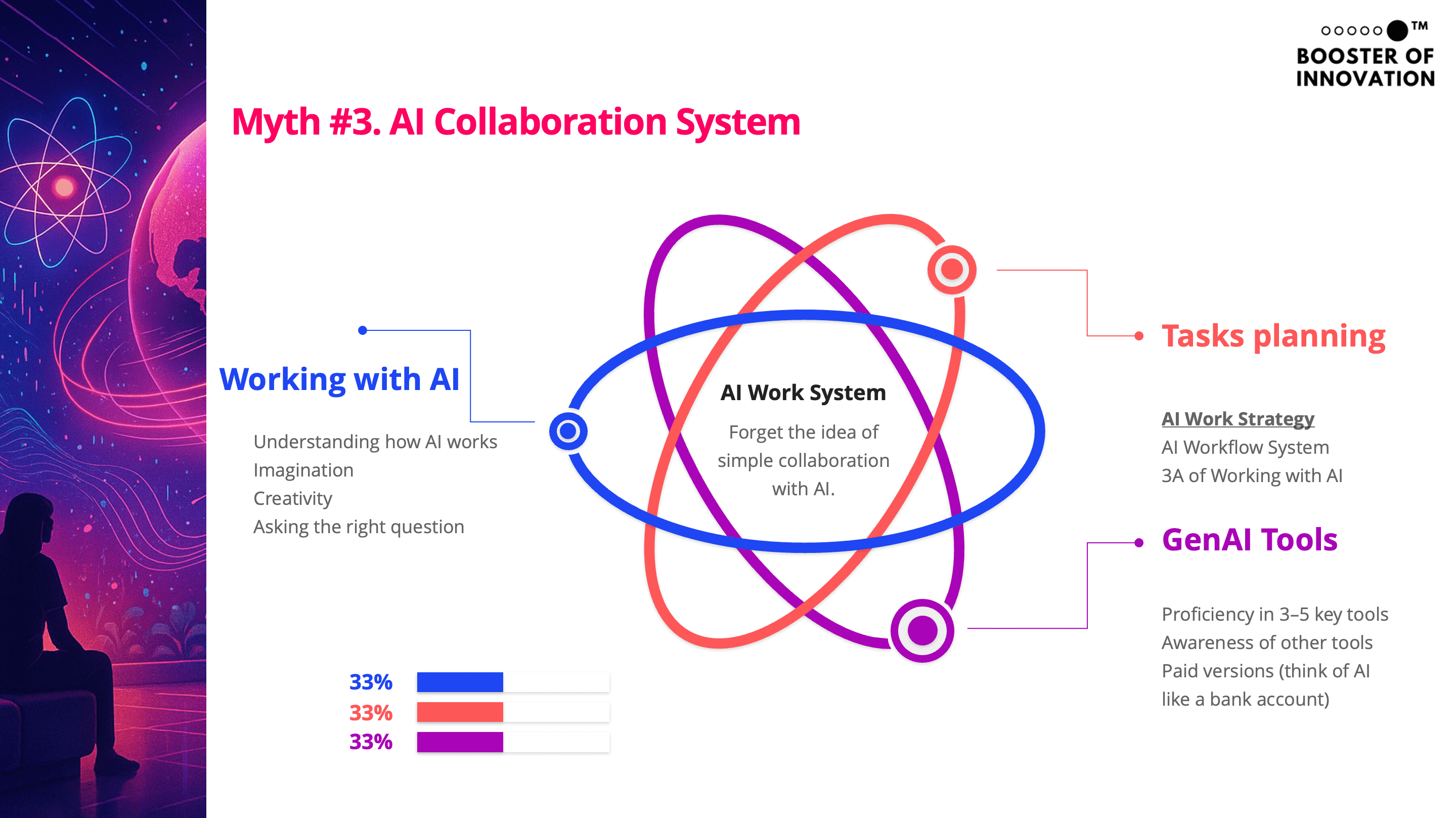
- Working with AI: Understanding how AI works, using creativity to frame problems, and asking the right questions. What you ask—and how you ask it—makes a big difference.
- AI Workflow System: Planning tasks and setting up a system like the “3A of working with AI – Automate, Assist, Augment” helps to optimise productivity and maximise value.
- GenAI Tools: It is essential to know how to use 3–5 key generative AI tools and be familiar with others. Investing in AI premium tools can be compared to having a bank account—necessary for modern life and a good return on investment. A structured online course can be a smart next step.
Don’t let a simple interface fool you. Effective AI use requires developing skills in all three areas. AI learning is a continuous journey—and always will be.
Myth #4: AI is only suitable for repetitive, routine tasks
Is AI just for automating repetitive tasks? Many believe that AI is mainly for relieving us from tedious work. But automation is just one of AI’s capabilities.
According to the Harvard Business Review article “How People Are Using AI in 2025”, repetitive tasks comprise only one-third of AI’s potential. AI can do much more—especially in business and strategic tasks.
To better understand AI’s full potential, consider these three categories of tasks it can support:
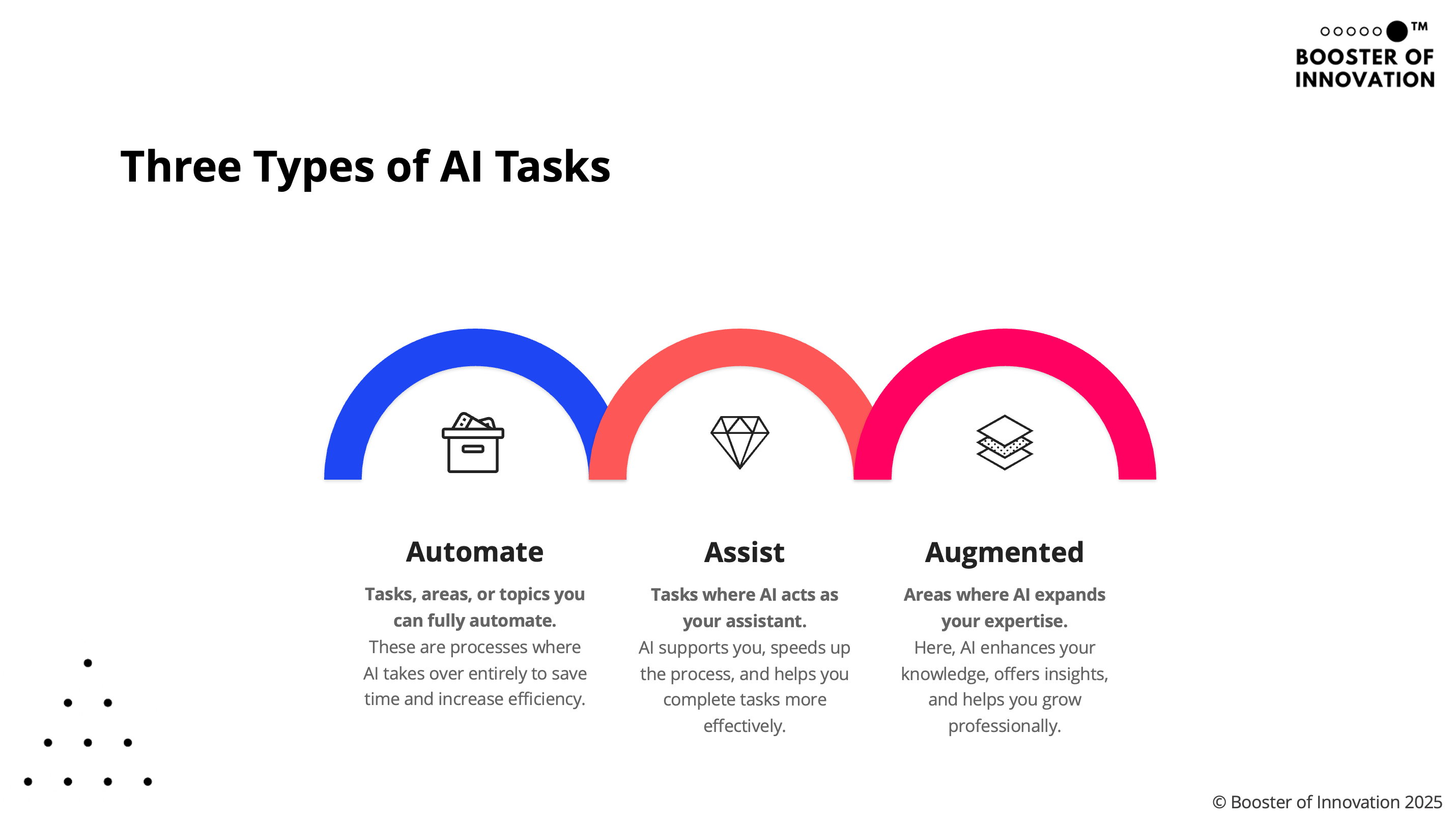
- Automate – Tasks that AI can handle entirely to improve efficiency.
- Assist – Tasks where AI helps and supports us, speeding up our work.
- Augment – Areas where AI enhances our skills and knowledge, offering new insights and professional development opportunities.
The 3A framework (Automate, Assist, Augment) comes from our Innovation Briefing: GenAI Productivity Plus report.
To download a preview or request the full report HERE.
Focusing only on automation limits AI’s real transformative power. Its value lies in supporting and enriching our work—especially in areas we often overlook or don’t have time for.
Myth #5: AI hallucinations are always a problem
Why is it important to understand how AI works? Because even its flaws—like hallucinations—can be used creatively.
AI hallucination means that generative AI always answers, even if it doesn’t know the correct one. While often seen as a flaw, hallucinations can produce creative and unexpected ideas.
Example? Use your Gallup test results to ask AI for career development ideas, reskilling suggestions, or side business opportunities based on your top strengths. The answers must be verified, but hallucinations can bring fresh and valuable insights.
Instead of rejecting AI hallucinations as mistakes, we should learn to interpret them as sources of inspiration and new directions—while constantly checking the facts.
AI – Conductor or Instrument? The Key to Your Transformation with AI
We’ve explored five common myths about AI—from prompt simplicity to hallucinations and assumptions about routine tasks. We hope this article has given you a new perspective and helped you realise how myths impact your AI effectiveness.
The future doesn’t belong to those who use AI but those who know how to use it well.
Think of AI not as a tool that makes noise but as a conductor that brings together your resources (your orchestra) and turns your prompts into powerful results. But without a skilled human conductor, the orchestra remains silent.
Now, ask yourself honestly: Which AI myths did you believe the most? Were you surprised by the reality of AI’s potential, its creative hallucinations, or its value beyond routine work?
Let’s demystify AI together. This will help us understand how this technology is reshaping the job market in Poland and how you can benefit from it.
AI Your Way – Join Our Free AI Webinar
If you want to become a true AI virtuoso, understand the future of work in the AI era, and fully harness its power in your life and career, join our AI webinar series: “AI Your Way”.
Learn how to prepare for your professional transformation with AI and turn this technology into your personal “Booster of Change.”
Sign up now HERE: https://boosterofinnovation.com/ai-po-twojemu – your starting point to understanding AI, even as a beginner. We’ll show you where to start, how to keep learning, and how to make AI your ally and growth engine.
A kind request 🙂
If you find the article inspiring, please share the link with your friends and post about it on LinkedIn. You can download the graphic below.






0 Comments