

The M-shaped model defines a new elite in the labour market: professionals with deep expertise across several domains (typically three), combined with a strong ability to synthesise them.
In the age of AI, where narrow specialisation (the I-shaped model) is more vulnerable to automation, the M-shaped model serves as a strategic form of career insurance, offering a unique blend of expertise and cognitive flexibility essential for managing complex ecosystems.
Origins and evolution: from “T” to “M”
The traditional T-shaped model is no longer sufficient in a world where technology life cycles have shrunk to just 2–3 years. Rapid technological and business change means that a single specialism supported by broad general knowledge is no longer enough to build a lasting competitive edge in terms of capability.
In this context, the M-shaped model emerges from the development of several areas of deep expertise. An M-shaped specialist is not a “do-it-all” person — in other words, not a classic generalist. Rather, they are professionals with multiple advanced capabilities that complement one another and create value at the intersection of different fields.
Example 1. A Chief Technology Officer may combine deep expertise in Machine Learning, intellectual property law and behavioural psychology, enabling them to develop technology, protect innovation and design solutions that take user behaviour into account — all at the same time.
Example 2. An HR expert may possess advanced capabilities in recruitment, data analytics, and digital marketing, using them to strategically build employer branding and make data-driven decisions.
The key to market value in the M-shaped model does not lie solely in the pillars of specialisation themselves, but in the space between them. It is precisely at the intersection of different disciplines that innovation most often emerges. For example, a person combining expertise in BioTech and Data Science may spot patterns in genome sequencing that remain invisible to both a pure statistician and a biologist working solely within the boundaries of their own discipline.
The new role of leaders
As the M-shaped model gains ground, the role of organisational leaders is changing as well. The leaders of the future no longer manage work outcomes alone — they manage the architecture of capabilities within the organisation.
Their task is to design an environment in which employees can develop multiple pillars of expertise, combine knowledge from different fields and rapidly adapt new skills in response to changing technologies.
In practice, this means moving from managing job titles to managing a portfolio of capabilities that the organisation develops and deploys across projects, innovation and business transformation.
The leaders of the future no longer manage work outcomes alone — they manage the architecture of capabilities within the organisation.
An edge at the intersection of multiple specialisms
The M-shaped model is a response to two parallel developments in the labour market. On the one hand, we are seeing the growing impact of automation and the adoption of artificial intelligence in the workplace. According to forecasts presented by leaders at the World Economic Forum in Davos, these technologies could reduce the time required to perform many tasks in existing roles by 30–40%.
On the other hand, we are seeing the emergence of augmented jobs – roles in which AI is used to expand the scope of tasks. This enables employees to acquire new, often quite distant, capabilities more quickly and to combine different areas of specialisation.
Unlike the T-shaped model – which assumes one deep specialism supported by broad general knowledge and soft skills – the M-shaped model is based on building several pillars of deep expertise (symbolised by the “legs” of the letter M).
Their value increases when they are grounded in strong general, interpersonal, and technological capabilities, which enable them to integrate different bodies of knowledge and create unique value at the intersection of disciplines.
Resilience and antifragility
In career development terms, the M-shaped model can be seen as building a portfolio of capabilities. Instead of anchoring their market value in a single specialism, the professional develops several areas of deep expertise.
As a result, when one capability is devalued by technological progress or automation – for example, basic coding being replaced by AI tools – the remaining pillars, such as business strategy or AI ethics, allow a career to shift its centre of gravity quickly. In effect, the specialist retains their expert standing and ability to create value, rather than losing both in the wake of a change in the technological paradigm.
The acceleration of expertise
In the M-shaped model, building expertise is no longer a process stretched over decades. Drawing on the Pareto principle and intensive learning methods such as Ultralearning, it is possible to build a new pillar of capability within 24–36 months by focusing on the critical 20% of knowledge and skills that drive the desired outcomes.
It is worth stressing that the M-shaped concept moves away from collecting degrees or courses and instead prioritises concrete skills acquired through practice. As a result, certifications that validate learning by doing are becoming more important, while certificates issued via blockchain technology are intended to guarantee the credibility of newly acquired capabilities.
Artificial intelligence plays a crucial role in acquiring new skills — whether as a mentor introducing someone to a new field (in the form of an AI Assistant), or as a sparring partner who, at a more advanced level of knowledge and capability, both stimulates strategic, analytical and critical thinking and tests understanding, simulates difficult situations and accelerates the acquisition of experience.
Not to be overlooked are the new metacognitive skills — the ability to accelerate one’s learning, as well as the ability to unlearn: consciously discarding outdated patterns and rapidly adapting to new tools and operating models.
From time management to managing energy and attention
In a world of intensive automation, human advantage increasingly stems not from knowledge alone, but from the ability to manage one’s cognitive and energetic resources.
Organisations are beginning to apply insights from Cognitive Science and concepts such as Cognitive Load Theory to reduce the excess of stimuli and digital tools, thereby protecting the “cognitive bandwidth” needed for deep work.
At the same time, the practice of intelligent job crafting is developing, in which employees use AI to free themselves from operational tasks and redesign their roles to focus on more developmental activities.
HR leaders are also increasingly viewing productivity through the lens of biology, drawing on Chronobiology, energy management throughout the working day, and even elements of biohacking, in order to create workplaces that best support cognitive performance – from eliminating cumbersome IT systems and applications, to designing more user-friendly processes and procedures, and even creating specially designed interiors and workspaces, aligned with the latest discoveries in neuroscience, to enable micro-recovery during the working day.
Within this approach, somatic intelligence and the ability to regulate stress in an environment of intensive algorithmic work also become critical. Ultimately, however, even the most advanced analytics still require human interpretation – which is why one of the most important capabilities of the future is becoming data storytelling: the ability to translate data into a compelling narrative that supports business decisions.
The beneficiaries of the M-shaped model
The M-shaped model brings benefits to both employees and organisational leaders. From the employee’s perspective, it means building career antifragility – instead of being a replaceable resource, the individual becomes a unique node in the organisational network, capable of connecting different areas of knowledge, such as finance, AI and psychology.
Such a combination enables them to act as a “translator” between functions, significantly increasing both their market value and their negotiating power. At the same time, the ability to rotate between different specialisms reduces the risk of stagnation and burnout, while developing additional pillars of capability strengthens cognitive agility and the ability to spot links across disciplines.
From a leader’s perspective, teams composed of M-shaped profiles enable the reduction of organisational silos, faster decision-making, and more flexible allocation of capabilities when strategy changes. As a result, the organisation operates as an environment of continuous knowledge recombination – a kind of innovation laboratory in which new ideas emerge at the intersection of disciplines.
How organisations are implementing the M-shaped model
Organisations that are intensively adopting AI are increasingly observing that some of their employees’ existing responsibilities are being shortened or automated. In response, many companies are launching development programmes to support the building of M-shaped capabilities.
The first stage is awareness-building among employees: explaining what the M-shaped model is, what changes are taking place in the labour market, what role artificial intelligence plays, and in which direction the organisation wants to develop the team’s capabilities. C
ompanies then analyse current capabilities and future needs, taking into account the impact of AI on specific domains of expertise. On that basis, personalised development pathways are created, based on microlearning, micro-tasks and project experiments that allow employees to build new skills in practice.
The next step is identifying strategic future capabilities – such as data analytics, AI agent management, cybersecurity or AI-driven innovation – and creating central development programmes for M-shaped capabilities around these areas.
For employees, an important benefit of such initiatives is the opportunity to navigate the change process within a learning community in a coordinated organisational environment. This reduces the stress associated with transformation while simultaneously developing a key meta-capability of the future: the ability to learn new specialisms rapidly – often within 2–3 years, rather than 8–10 years, as was common in traditional career models.
Leaders as capability architects in the age of AI
The M-shaped model is not a passing development trend, but a response to a fundamental shift in the architecture of work in the age of artificial intelligence. In a world where algorithms are taking over more and more operational tasks, the importance of people who can connect different fields of knowledge, interpret complex systems and create value at the intersection of technology, business and the human sciences is growing.
For employees, this means deliberately building a capability portfolio; for organisations, it means designing work environments that enable the development of multidimensional expertise. Leaders play a pivotal role in this process, as they are increasingly no longer managing work outcomes alone, but designing the architecture of capabilities within the organisation – creating the conditions for learning, experimentation and the development of new specialisms.
It is precisely these capability profiles that will drive innovation, make strategic decisions and collaborate with AI systems in the coming years in ways that enhance, rather than diminish, human potential.
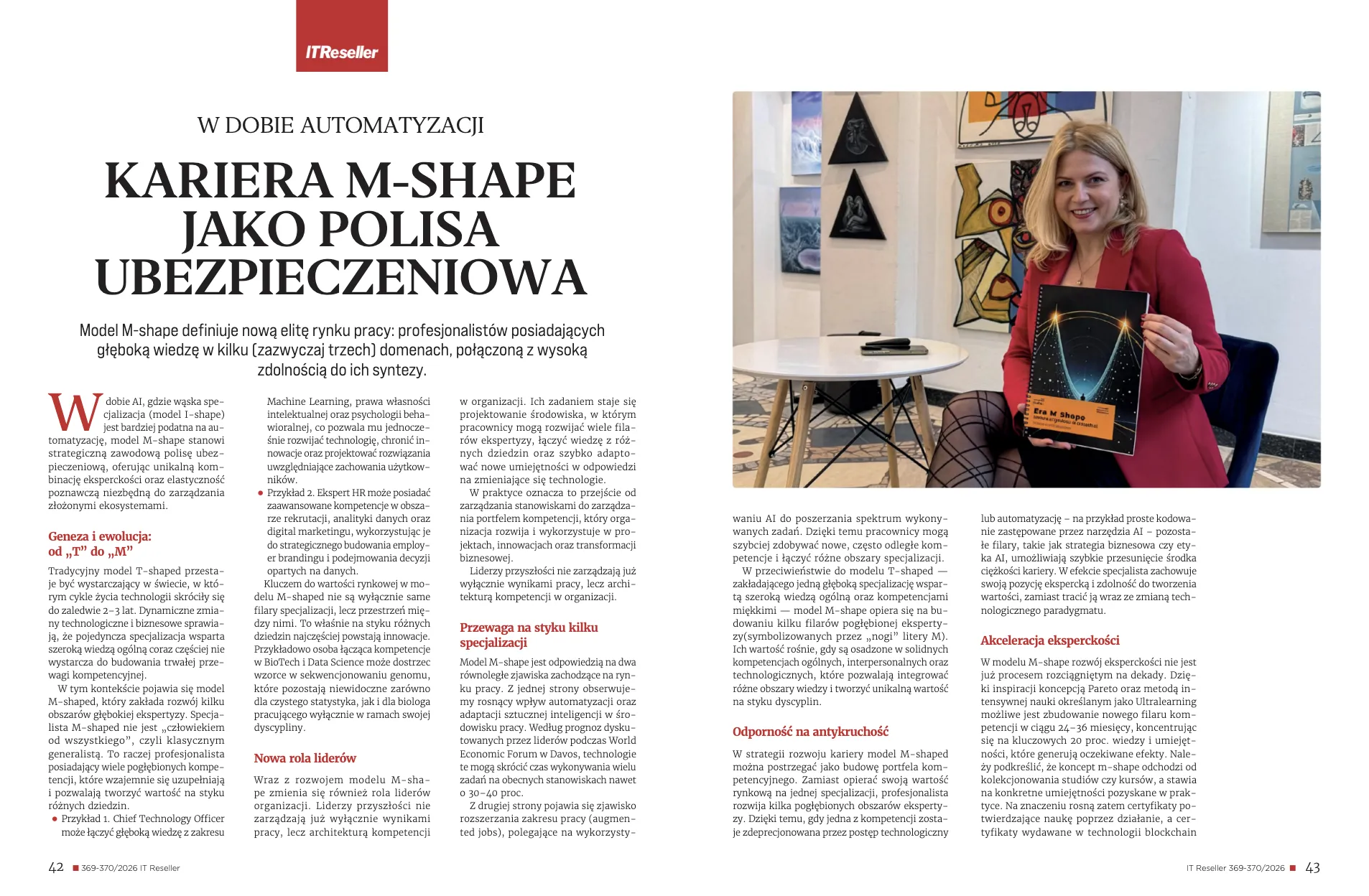
If you are interested in the M-shaped model in organisations, it is worth exploring the report published by Booster of Innovation, “The M-Shape Era: The Career of the Future in the Age of AI.”
The publication includes key insights into this direction of labour market development, research findings on the role of artificial intelligence and human-AI collaboration in the process of building new capabilities, as well as numerous implementation examples and inspiration from organisations that are already creating work environments based on the M-shaped model today.
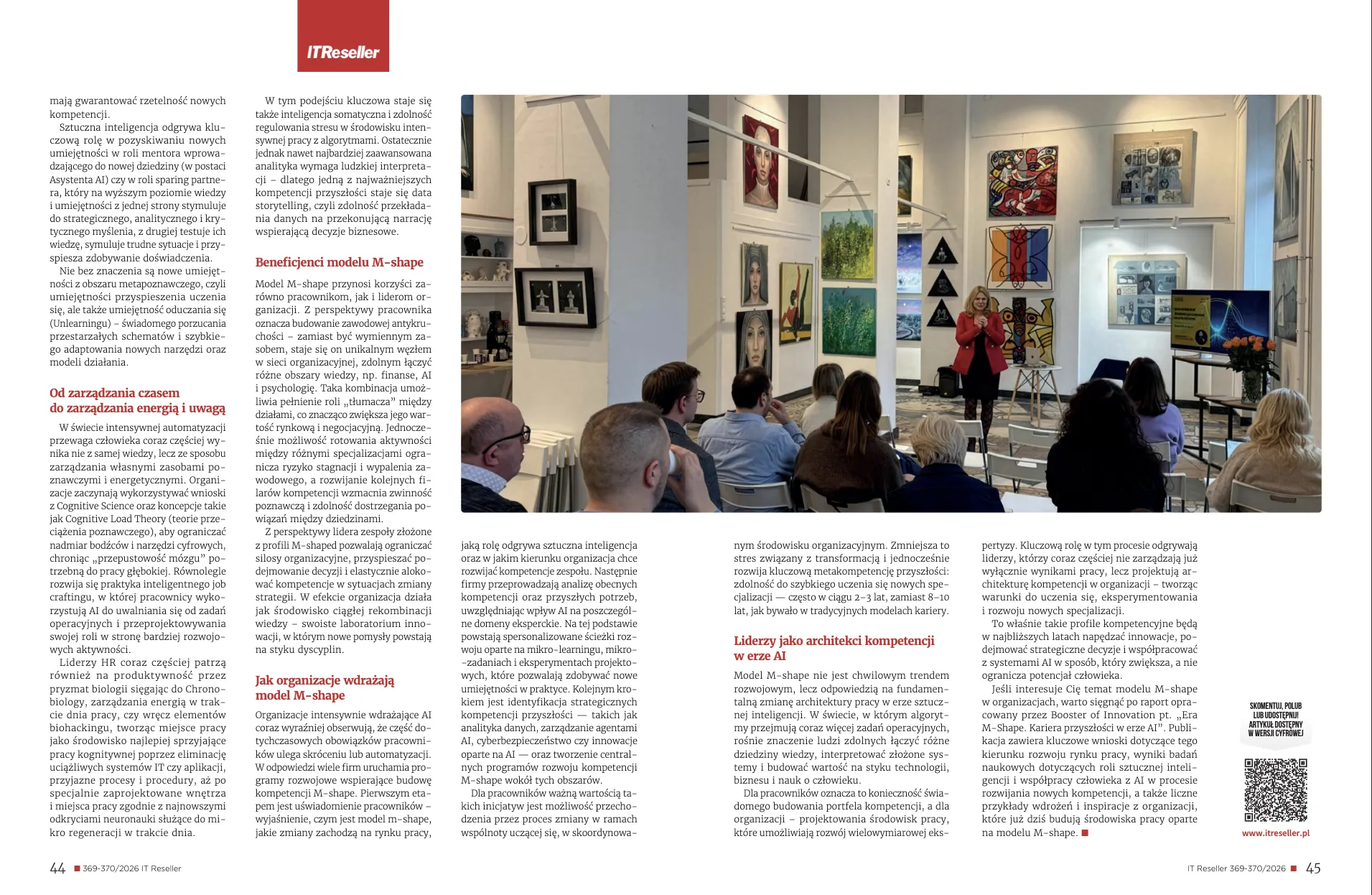
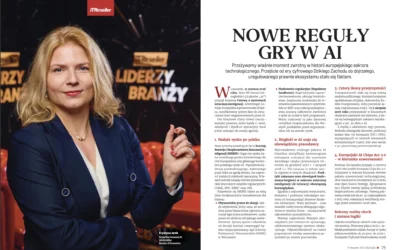
The article was published in the most popular technology magazine among tech companies.


0 Comments