

In the first article in our series on Future Days and strategic foresight, we outlined a fundamental shift taking place in global business: moving away from theoretical predictions about the future and towards actively practising it.
This naturally raises another critical question for senior leaders: How can this practice be organised within a company’s structures?
The answer presented at the Future Days 2026 conference in Copenhagen was clear: treat organisations, partner ecosystems and urban spaces as Living Labs-living systems where people, technologies and institutions experiment together in real time, not isolated environments for discussing change.
From Events to Innovation Ecosystems
Most traditional business conferences and internal strategy summits still follow an outdated formula: an expert on stage, an audience seated in rows, a flood of presentation slides and, once everyone returns to the office, a return to business as usual.
Future Days 2026 demonstrated that this model is becoming a thing of the past. The modern architecture of transformation is based on three important shifts:
- From days filled with theory → to days filled with experiments conducted within real systems.
- From passive participants → to co-researchers and co-designers of change.
- From a closed conference room → to a testbed and proving ground for prototypes.
In the Living Lab model, a strategic event is not a closed bubble. It becomes a node within a continuous innovation process. Business partners are no longer merely sponsors. They become co-owners of experiments, while real-time data feeds directly into decision-making processes.
Urban Foresight in Action
During Future Days, Copenhagen was used as a large-scale experimental environment. Instead of analysing abstract charts, leaders entered the urban space and applied the principles of Urban Foresight:
- Sensing the City. Participants explored selected districts as “living dashboards”, observing how climate, design, data and social life influence one another on the streets.
- Experimental walks. Every day, routes became exercises in exploring the future. Where can we already see signals from 2035? Who benefits from today’s technological solutions, and who is excluded by them?
- Contextual dialogue. Conversations with residents, public officials and activists grounded theoretical debates in real-world experience.
For business leaders, the key takeaway is clear: genuine transformation and technological innovation come from engaging directly with real-user interactions and market tensions, not just analysing theory. Without moving beyond PowerPoint, companies risk overlooking subtle but critical signals that affect implementation success.
Design as a Bridge
Living Labs need precise tools for turning ideas into action. Today, the most significant innovations are created at the intersection of three areas: Leadership – procedures and resource allocation; Technology – AI systems and data infrastructure; and Society – the needs of employees and customers.
In Copenhagen, design acted as the bridge connecting these three worlds:
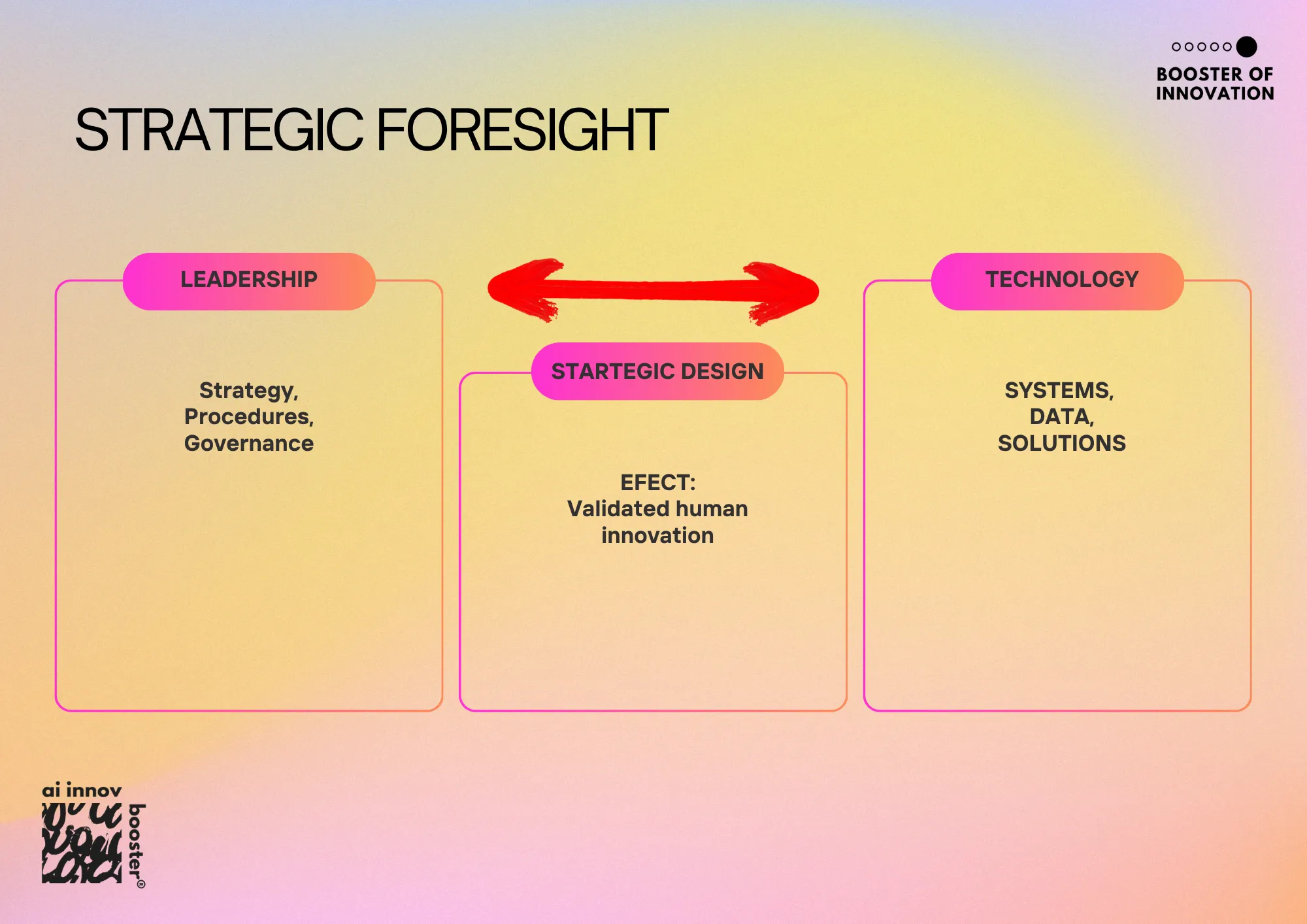
Through speculative and participatory design, ambitious strategic goals, such as “implementing responsible AI”, stopped being generic corporate slogans. They began to take the form of physical interfaces, service models, and specific user journeys that could be tested, assessed, and improved immediately.
A Practical Guide: How to Launch a Living Lab in Your Company
Bringing this philosophy into a corporate environment does not require a major financial investment at the beginning. It requires a change in approach.
Below is a simple six-step framework that can be introduced in your organisation.
1. Choose a System, Not a Topic
Instead of working with broad and generic themes, such as “AI in the company”, identify and isolate a specific, tangible process. For example, focus on a narrow area such as “Artificial intelligence in the customer complaints process.” This narrows the research perspective to a measurable, directly observable process. It also prevents blurred accountability and confusion around definitions.
2. Map the Real Stakeholders
Invite representatives from every level involved in the system to work together directly. The project team should include developers, front-line employees, compliance specialists and end customers. This ensures genuine diversity of perspectives, known as co-framing, and helps prevent siloed thinking when defining the problem.
3. Design the Experience
Physically leave the meeting room. Follow the real customer journey, conduct shadowing of the operational team’s daily work, and experience the barriers they face firsthand. The aim is to collect real, unfiltered signals from the market and the organisation – a process known as sensing – rather than relying only on formal reports.
4. Run a Co-Creation Process
Organise a workshop based on the observations collected together and the tensions already mapped. Use these insights to develop the first practical concepts for potential solutions and targeted interventions. This helps the organisation make full use of its collective intelligence while also building a sense of ownership among employees involved in the project.
5. Test a Small Change Quickly
Do not wait for perfection. Create and introduce a simple, low-cost prototype immediately. It could be a minor change to a system interface, a quick adjustment to an internal procedure or a basic automation script. The purpose is to test your assumptions under real operating conditions, with minimum business risk.
6. Learn and Decide
Document the test carefully. Identify what worked well and what failed. Based on the results, make a clear management decision: should the solution be scaled across the company, modified and tested again, or abandoned completely? This formally closes the organisation’s learning loop and clearly assigns business responsibility for the next steps.
How We Do It at Booster of Innovation
From One-Off Initiatives to Permanent Infrastructure and Readiness for Uncertainty
The greatest challenge for organisations is not running one successful innovation workshop. The real challenge is continuity. A Living Lab is an ongoing strategic infrastructure. It helps a company keep learning, adapting, and responding to change. Key takeaway: Living Labs support continuous growth and resilience, not just one-time projects.
At Booster of Innovation, we support boards and strategy teams in building transformation structures for the future. Our advisory tool, Future Briefing, serves as the foundation for creating Living Labs within organisations. Through the strategic analysis delivered as part of Future Briefing, we provide companies with a map of intersecting technological and market currents.
However, we do not leave you with theoretical knowledge alone. We show you how to translate these trends into specific points of contact within your company. We help you design routines, governance structures and micro-pilots that can transform your organisation into a flexible, self-learning Living Lab.
Let’s Meet
To learn how a Future Briefing Report is created, who we work with and what benefits companies gain from our analysis, please get in touch.
This article concludes the second part of our four-part Booster of Innovation series on foresight’s emerging paradigm.
In the next article, we will examine the perspective of supervisory boards and executive committees: How can insights from Living Labs be translated into portfolio strategy and corporate governance that enables organisations to manage capital effectively in conditions of extreme market uncertainty?




0 Comments