

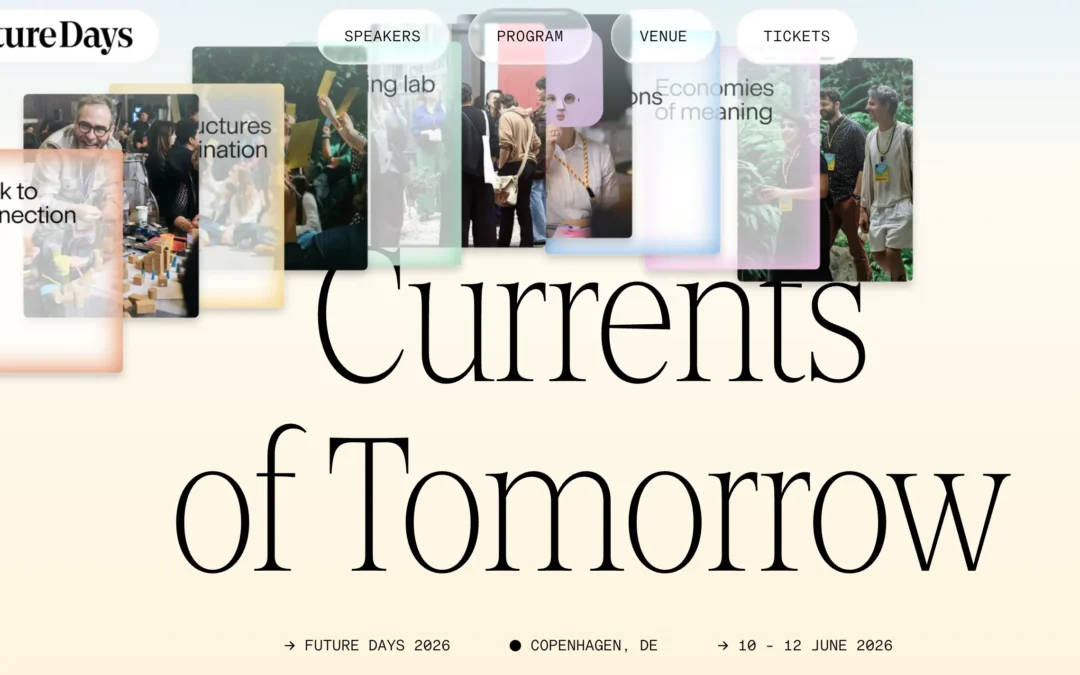
In the previous articles (check out here and here), I outlined a clear pattern in the modern approach to the future. The Future Days 2026 conference in Copenhagen was not simply another festival of trends. It was a living demonstration of how organisations can deal with uncertainty: by sensing change in the real world, experimenting together and treating organisations as Living Labs.
However, every senior manager and board member will eventually ask the fundamental question:
How can we translate these inspirations into hard strategy, corporate governance and investment decisions that genuinely change the way we operate?
This final article in our series addresses that challenge. It shows how to connect the chaos of market currents with the precision of project portfolio management.
From Buzzwords to Mapping Systemic Currents
Most strategic presentations still organise the world into a series of dry bullet points: “AI, climate change, regulation and the competition for talent”. While this may be useful for general orientation, it hides an essential aspect: the interactions between these forces.
The concept of Currents of Tomorrow offers a much stronger way of thinking:
- A current is not a single trend. It is a dynamic flow of change with its own direction, momentum and business consequences.
- Currents interact with one another. They strengthen, collide with or neutralise each other, much like ocean currents.
- No organisation controls every current, but every organisation takes a specific position in relation to them.
In financial services, these currents may include the simultaneous tightening of AI regulations and the evolution of climate risk. In the industry, they may involve the collision of process automation with the changing expectations of younger generations of employees.
The board’s role is to map these currents and define the organisation’s position with precision:
- Where are we moving against the current by creating new standards and infrastructure?
- Where are we operating in the mainstream, with significant exposure but only partial influence?
- And where are we simply moving with the current as price takers, absorbing the effects of changes we do not control?
Building a Project Portfolio Around Market Currents
Once you begin to think in terms of currents, the logic of your strategic portfolio changes completely.
Instead of investing in one “heroic” transformation programme based on a single, predetermined vision of the future, or creating a long list of disconnected initiatives competing for budget, you move towards managing a portfolio diversified around different currents.
Below are three examples of how such a portfolio can be structured using the model:
- Market current > Example portfolio initiative > Strategic objective and optionality
- AI Governance and Ethics > A pilot of explainable credit scoring using Explainable AI > Securing regulatory compliance and building trust.
- Climate and Resilience > Green financial products linked to local ecosystems > Capturing market niches and reducing ESG risk.
- Social Trust and Inclusion > New, transparent standards for communicating algorithmic decisions > Improving customer retention and building strong brand equity.
This approach makes it much easier to identify systemic errors and organisational biases.
When 80% of your investment supports only the current of efficiency and automation, while resilience and trust-building are largely ignored, your portfolio becomes highly vulnerable to shocks. Portfolios do not eliminate uncertainty. They treat it as a key design parameter.
Foresight as Permanent Organisational Infrastructure
For portfolios based on market currents to work in practice, a company needs more than individual projects. It needs an internal foresight infrastructure.
Drawing on the experience from Copenhagen, a modern organisation should introduce four key pillars:
- People – Futures Stewards.
Ambassadors of the future are embedded directly within business units, rather than locked away in an isolated R&D department.
- Processes.
Regular operational rhythms are divided into sensing (including signal scanning), converging (including portfolio reviews and scenario sessions), and integrating (including budgeting cycles).
- Tools.
Active maps of market currents, weak-signal databases and management dashboards that monitor changes in the external environment.
- Decision-making forums.
Strategy committees and supervisory boards that intentionally include scenario analysis on their agendas.
The aim is not to create another layer of bureaucracy. The principle is much simpler: every major investment decision should clearly show which currents it responds to and how the proposed solution would perform in at least two different future scenarios.
Leadership in the Era of Future Currents
All of this redefines the role of the modern leader. The traditional model of leadership, in which the leader is expected to have the best answers and the most accurate forecasts, is becoming a thing of the past. In a complex and volatile world, the new leadership model is the leader as a sensemaker and portfolio curator.
Their task is to design spaces where diverse teams can map the system together, balance investment bets based on incoming data, and manage trade-offs transparently in front of the organisation and its shareholders.
The 90-Day Challenge
Bring Copenhagen into Your Boardroom
The insights from Future Days 2026 only have value when they lead to specific decisions within your company. Below is a 30-60-90-day action plan that can be introduced immediately.
- Days 1-30: Name the currents. Bring together a cross-functional team and identify four to six major currents shaping your business. Develop a shared language and clear definitions for each of them.
- Days 31-60: Map the portfolio. Review the list of projects currently being delivered across the company. Assign each project to the relevant currents. Identify gaps, overlaps and areas where capital is excessively concentrated.
- Days 61-90: Launch a micro-cycle. Select one area, such as a specific service or business unit, and run a complete Sensing > Converging > Integrating cycle. Test one rapid prototype and bring the findings directly onto the board’s agenda.
How Does Booster of Innovation Help Secure Your Strategic Future?
Working with market currents and building flexible innovation portfolios is at the heart of what we do at Booster of Innovation. Our flagship product, Future Briefing, was designed to remove the burden of information overload from boards and transform it into a structured source of market advantage.
As part of Future Briefing, we do more than identify and map the technological and regulatory currents specific to your industry.
We help you design the foresight infrastructure described in this article and introduce a new generation of corporate governance. We transform static plans into dynamic innovation portfolios that allow your company to allocate capital intelligently and remain fully steerable, regardless of which direction the currents of tomorrow may take.
This is the final article in our series exploring the lessons from Future Days 2026. Thank you for joining us on this journey from predicting the future to actively practising it.
Let’s Start the Change Today
When you are planning a strategic currents mapping session for your company or looking to introduce a Living Lab model, get in touch with us.
As your strategic partner, we will help you turn these methodologies into a practical agenda and a clear process designed to protect your organisation’s market position for years to come.
Let’s Meet
To learn how a Future Briefing Report is created, who we work with and what benefits companies gain from our analyses, please get in touch.


0 Comments